


War On, War Off: The Greatest Game Show On Earth
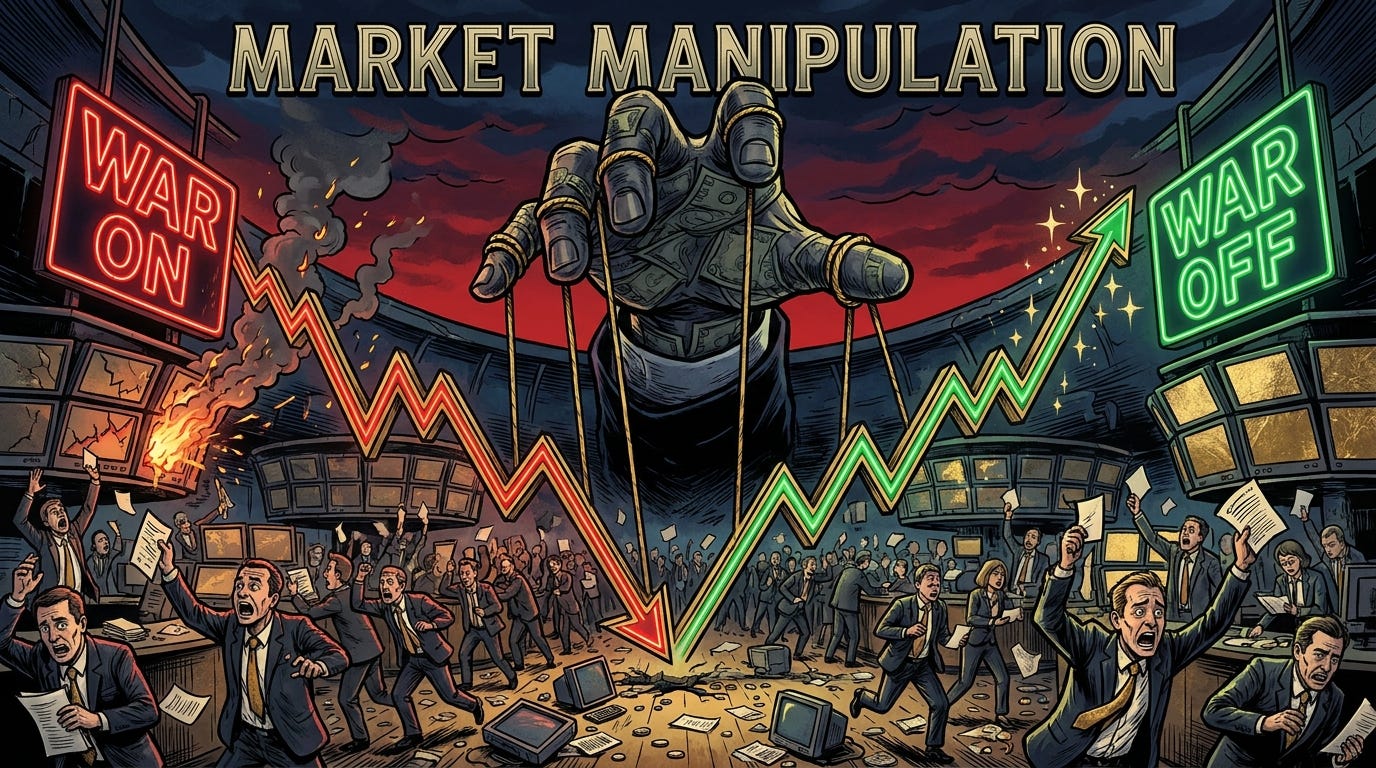
I want you to picture the trading floor. Not the old-school one with guys screaming and throwing paper, but the modern one: rows of monitors, algorithms doing most of the actual “thinking,” and somewhere in a windowless room, a junior staffer refreshing a government official’s social media feed like it’s the last lifeboat off the Titanic. Because these days, that’s basically what it is.
A single sentence. That’s all it takes now. “We are considering all options.” Dow drops two hundred points. “Talks are progressing well.” Dow recovers three hundred. Nobody fired a shot. Nobody signed a treaty. Somebody just typed a sentence that sounded vaguely ominous or vaguely hopeful, and trillions of dollars did the electric slide in response. If you think that’s a coincidence, I have a bridge to sell you, and weirdly, the bridge’s stock price will probably spike the next time someone mentions “infrastructure resilience” in a press conference.
Here’s the part nobody wants to say out loud at the dinner table. War talk is not just diplomacy anymore. It’s a product. It’s content. Somewhere between “geopolitical strategy” and “quarterly earnings call,” the line got so blurry you’d need a forensic accountant and a priest to find it again. Every escalation is a mini-IPO for defense contractors. Every de-escalation is a rally for airlines and consumer discretionary stocks. And every single time, there’s a very convenient cluster of people who happen to know which way the headline is about to break before the rest of us do. Funny how that works. Almost like it’s designed.
I’m not saying every official standing behind a podium is twirling a mustache and calling their broker mid-sentence. I’m saying the system doesn’t need a mustache-twirler. It just needs incentives, and boy, does it have incentives. When your reelection fund, your post-office consulting gig, and half your donor base’s portfolios are all sitting pretty on defense and energy stocks, “restraint” starts to look like a financial liability. Peace is nice. Peace doesn’t fund a super PAC.
And the public? We’re the studio audience. We get the highlight reel: the somber face at the podium, the “grave concern,” the “monitoring the situation closely,” while somewhere upstream, someone already adjusted their position. By the time the evening news tells you what happened, it already happened financially, hours ago, in rooms you weren’t invited into. You’re not watching the market react to the news. You’re watching the market react, and then the news gets written to explain the reaction. It’s backwards, and everyone just agreed not to mention it.
The most insulting part isn’t even the manipulation. It’s the laziness of it. Nobody’s cooking up elaborate conspiracies in smoke-filled rooms anymore, because they don’t need to. All it takes is a vague word choice. “Imminent.” “Unprecedented.” “All options on the table.” These aren’t policy statements, they’re mood lighting. They’re engineered to be interpreted, not understood. Ambiguity is the whole business model, because ambiguity is what moves markets without anyone technically lying. You can’t get subpoenaed for a vibe.
And when the correction comes, when it turns out the “crisis” quietly de-escalated three days later with a joint statement nobody read, who actually loses? Not the people who traded on the whisper. Not the outlets who ran seventeen headlines with question marks instead of periods. It’s the retail investor who panic-sold, the pension fund that hedged too late, the regular person who doesn’t have a Bloomberg terminal or a friend at the briefing. The house always wins. The house just changed venues from Vegas to the Situation Room.
I keep waiting for the moment where enough people say, “wait, hold on, why does the stock market move like it has advance knowledge of our foreign policy before our foreign policy has actually been decided?” But that moment doesn’t come, because by the time we’re done being outraged about the last headline, there’s a new headline, engineered with the exact same emotional trigger, and the cycle resets like a very profitable Tuesday.
Call it corruption if you want the polite word. Call it market intelligence if you’re the guy doing it. Either way, the war isn’t the point anymore, and maybe it never fully was. The announcement is the point. The war is just the excuse for the announcement. And we, the audience, keep tuning in every single time, wide-eyed, like it’s not the same rerun with a different flag in the background.
Freedom to think clearly would be nice. Somebody should try it. In the meantime, watch the defense stocks before you watch the news. They already know something you don’t, or more accurately, someone made sure they’d know it first.