


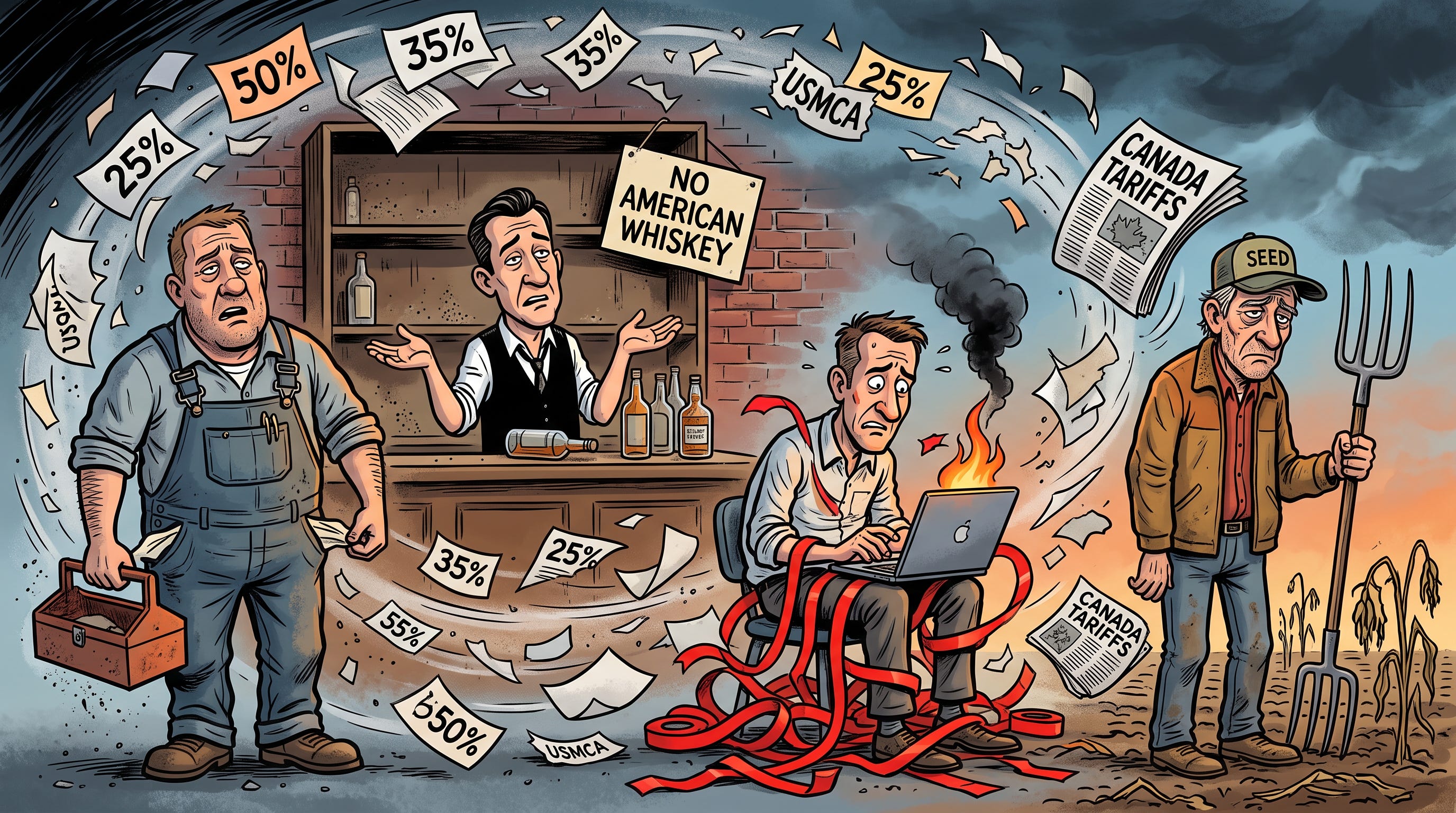
Let’s start with the punchline before we even get to the joke: Donald Trump signed the USMCA. He called it, at the time, the best trade deal ever made, a total replacement for the “disaster” of NAFTA, his own personal masterpiece. That was 2020. Fast forward to now, and the same man has spent the better part of two years treating that masterpiece like an Etch A Sketch he keeps shaking just to see what falls out. If you’ve lost track of how many times the Canada trade relationship has been “fixed,” “torn up,” “paused,” and “fixed” again, don’t worry, so has everyone else, including apparently the White House.
Let’s walk through it, because the whiplash really does deserve a timeline.
Round One: Fentanyl, Tariffs, and a Pipeline Nobody Asked About
Trump kicked things off in February 2025 by signing an order slapping 25 percent tariffs on nearly all Canadian goods (10 percent on energy), citing fentanyl trafficking and migration, despite the fact that a rounding error’s worth of fentanyl actually crosses the northern border compared to the southern one. Canada, then under Justin Trudeau, retaliated with tariffs on tens of billions of dollars in American goods. This is the trade equivalent of getting into a fistfight with your accountant.
By later in the year the tariffs on non-USMCA-compliant Canadian goods had climbed to 35 percent, and the fight kept escalating from there, with Canadian provinces yanking American liquor off shelves entirely. According to the White House’s own numbers, Canadian imports of U.S. alcohol cratered by about 81 percent over a year, and Canadian imports of U.S. vehicles fell by roughly 22 percent, or $5.6 billion. So the actual scoreboard from Round One: Americans paying more, Canadian liquor stores stocking literally anything but American whiskey, and a trade deal Trump himself signed treated as an inconvenience rather than a contract.
Round Two: The Supreme Court Says “Actually, No”
In February 2026, the Supreme Court ruled, 6-3, that the law Trump had been using to impose most of these tariffs, the International Emergency Economic Powers Act, does not actually give a president the power to impose tariffs at all. The Court called the tariffs “unbounded in scope, amount, and duration,” which is a very polite judicial way of saying “you cannot just make up taxes because you feel like it.” All of those IEEPA-based tariffs, the ones hitting Canada since March 2025 among others, were formally switched off by February 24, 2026. Analysts estimated the government had already collected more than $160 billion under a legal authority the nation’s highest court says never existed in the first place.
Most people, having just been told by nine Supreme Court justices that their signature economic policy was illegal, might take a beat. Trump took about four hours. On the very same day as the ruling, he signed a new proclamation invoking an entirely different law, Section 122 of the Trade Act of 1974, to reimpose a global tariff anyway, alongside a stack of separate “Section 232” tariffs on steel, aluminum, autos, copper, and lumber that were never part of the ruling to begin with. Rejected by the judiciary in the morning, right back to tariffing by the afternoon. That’s not stubbornness, that’s a hobby.
Round Three: “We Have a Deal!” (Narrator: They Did Not, in Fact, Have a Deal)
Then came the part of the show where things get almost operatic. In July 2026, the administration announced it would not renew USMCA in its current form at all, the very deal Trump had spent his first term bragging about, effectively putting the whole trilateral agreement into limbo pending “annual reviews.” A month later, with fresh 50 percent tariffs on Canadian goods hours from taking effect, Trump paused them and posted that the U.S. and Canada, “subject to finalization of documents,” had a DEAL, capital letters very much his own choice, and floated resurrecting the long-dead Keystone XL pipeline for good measure, as though that’s a thing you can just casually toss into a press release.
If that sounds familiar, it’s because it is almost word for word what happened back in October 2025, when Trump and Prime Minister Mark Carney met, Trump announced a “deal,” and floated the exact same pipeline. Two separate “DEALS” announced roughly ten months apart, both involving the same fantasy pipeline, neither one apparently sturdy enough to survive the following news cycle.
Sure enough, this most recent “deal” didn’t even make it a week. By August 24, talks had broken down again, with Carney vowing dollar-for-dollar retaliation on roughly $28 billion in American goods, and Trump firing back on social media that Canada has been “ripping off” the United States for years and threatening to hike tariffs on cars, trucks, and steel to 50 percent starting January 1, 2027. Canada, for reference, is the third-largest source of U.S. imports, more than $380 billion worth of goods in 2025 alone. This is not a minor trading partner you can afford to treat like a reality show contestant you’re deciding whether to bring back next season.
So, To Recap
In the span of about a year and a half: a trade deal was signed, then tariffed around, then partially struck down by the Supreme Court as flatly illegal, then reimposed under a different legal theory within hours, then not renewed at all, then “deal” announced with a dead pipeline attached, then that deal collapsed, then a second nearly identical “deal” was announced with the same dead pipeline attached, and that one collapsed too, landing us back at tariff threats as of this week. Canadian liquor stores still won’t carry American whiskey. Nobody involved seems to know if there’s an actual USMCA left to review in 2026 or just a folder full of expired press releases.
If you’re a Canadian exporter, a Michigan auto worker, or genuinely anyone trying to plan a supply chain more than three weeks out, the message from Washington has been remarkably consistent: nothing here is ever actually final, the deal is only as good as the next Truth Social post, and the closest thing to a stable trade policy with America’s third-largest trading partner is whatever mood the president is in on a given Monday. Best trade deal ever made, indeed. He just never said which version.
Sources:
NBC News, “Trump hits back at Carney, threatens to hike auto, truck, metals tariffs to 50%”
CNBC, “Trump pauses 50% scheduled tariffs on Canada for three days, announces ‘deal’ with Ottawa”
ABC News, “Trump’s 50% tariffs on Canada take effect as Carney vows to retaliate”
The White House, “Fact Sheet: President Donald J. Trump Imposes Additional Tariffs on Canada”
Congress.gov / Congressional Research Service, “U.S.-Canada Trade Relations”
Tax Foundation, “Supreme Court Trump Tariffs Ruling: Analysis”
WilmerHale, “Supreme Court Strikes Down IEEPA Tariffs—What Now?”
Fasken, “US Supreme Court Rejects IEEPA Tariffs: Key Takeaways for Canadian Businesses”